Provisional Government
Doctor ZhivagoThe Provisional Government is the national authority whose legitimacy becomes increasingly uncertain as the novel’s local conflicts unfold. Zybushino openly rejects it, while military commandants and revolutionary officials debate how to preserve order; the result is a portrait of authority fragmented among competing claims, coercive measures, and popular resistance.
Authority under pressure
In June, the grain center of Zybushino declares itself an independent republic. The initiative comes from the local miller, Blazheiko, and is backed by deserters from the 212th Infantry, who have left the front with their weapons and reached the town through Biriuchi. The republic refuses to recognize the Provisional Government and separates itself from the rest of Russia. Its challenge is not merely a change of administration: Blazheiko proclaims a millennial kingdom in which work and property are to be collectivized, and calls the local administration an Apostolic Seat.
The novel situates this separatist experiment in a place already associated with legends, unusual customs, and a reputation for fertile land. That history does not explain away the rebellion, but it gives the episode a local texture distinct from national political formulas. A remote grain center becomes a stage on which armed deserters and a religious dissenter attempt to establish a new order, directly repudiating the government’s claim to rule.
Military discipline and revolutionary contradiction
The government’s authority also appears through efforts to strengthen the army before a new offensive. Revolutionary courts-martial are established, and the death penalty—recently abolished—is restored. The measures expose a contradiction within the revolutionary moment: a government associated with a break from the old order turns to severe military discipline to sustain its forces and prosecute the war.
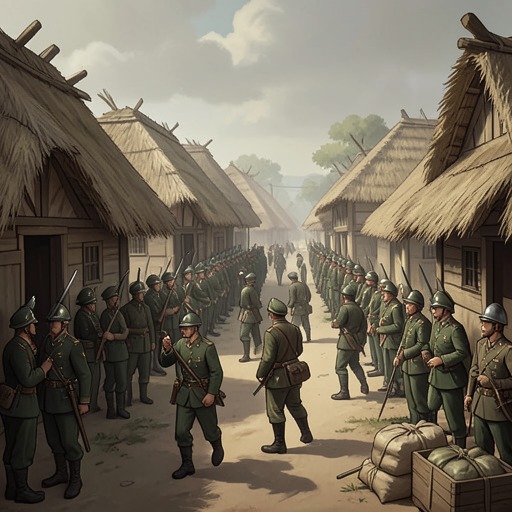
The conflict becomes concrete when a commandant proposes calling out a nearby Cossack regiment to surround and disarm the rebels. He describes the regiment as loyal and Red, and presents swift disarmament as the way to end the crisis. Commissar Gints rejects the plan. He insists that this is not 1905 and that the country must not return to prerevolutionary methods; he also accuses the generals of having outsmarted themselves. The exchange shows that opposition to the Provisional Government’s enemies does not produce agreement about how power should be exercised. The commandant prioritizes immediate coercion, while Gints frames the use of Cossacks as a betrayal of revolutionary principles.
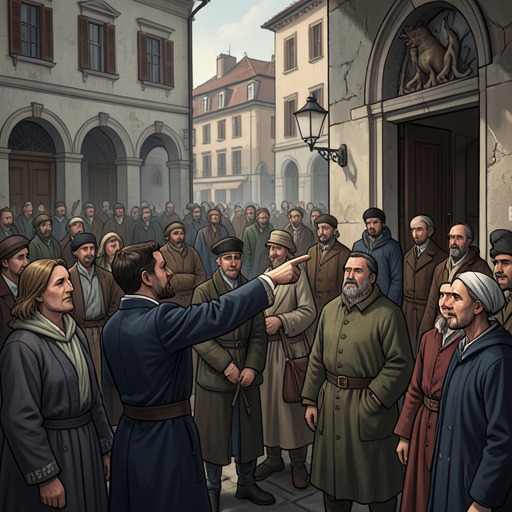
Gints carries that dispute into a public meeting in Meliuzeievo. Apparently asked by the municipality to lend his authority, he rebukes the townspeople for disorder and blames the Bolsheviks for instigating the Zybushino disturbances. He appeals to the threat of a powerful, ruthless enemy and to the country’s hour of trial. The audience does not receive the speech as a settled statement of authority: listeners heckle, call for silence, and argue over who may speak. The clash over the microphone—or, more precisely, the wooden platform and the rules governing speech—makes political legitimacy something contested in public rather than simply proclaimed from above.
The fraying reach of government
These episodes place the Provisional Government within a country where commands, loyalties, and political identities no longer align neatly. Zybushino rejects the government outright; military leaders consider force against the breakaway republic; and Gints opposes a tactic that he associates with the prerevolutionary past even as he speaks for authority against the revolt. His speech further identifies the Bolsheviks as agents of disorder, but the interruptions reveal that the crowd is not a unified audience ready to accept that account.
The wider military landscape sharpens the government’s predicament. Wounded men arrive at overcrowded Moscow hospitals, while the front’s movement and the German breakthrough force hospitals in a village to evacuate under fire. The war’s immediate demands—treating casualties, moving medical operations, sustaining troop morale—press upon a political system already struggling to command consent. The novel thus presents governmental power not as an abstract constitutional arrangement but as a claim tested against crowded wards, military emergencies, local defiance, and the practical limits of control.
A contested political interval
The Provisional Government matters in the novel less as a fully developed institution than as a measure of how quickly formal authority can be challenged. It is named as the government rejected by Zybushino, invoked amid military attempts to contain rebellion, and opposed in public by a commissar who fears a return to old methods. These distinct conflicts prevent any single political voice from standing unquestioned: the republic’s millennial collectivism, the commandant’s coercive proposal, Gints’s revolutionary rhetoric, and the crowd’s interruptions all compete to define what legitimate rule should mean.
The government’s place in this pattern is therefore precarious and transitional. Its existence does not settle who commands the army, how the rebels should be treated, or whose account of the crisis the people will accept. By showing those questions through a separatist republic, military discipline, and a disrupted public meeting, the novel renders political change as an unstable struggle over everyday acts of obedience, force, and speech.